
Arts and Humanities
Blogs
10 Min Read
Where the Mountain Still Speaks: Field Notes from the MSHI Photography Hike July 19, 2026
Ralf Wiegand
Pubished - August 05, 2026


MSHI is grateful to photographer and volunteer Ralf Wiegand for this first-hand field guide!
A Place that Asks Us to Listen
There are places that ask nothing of us except that we slow down and listen. Mount St. Helens is one of those places.
On the morning of July 19, 2026, our Mount St. Helens Institute (MSHI) Photography Hike began at the Harmony Trailhead, tucked away on the monument's quieter eastern side. Reaching this trailhead is an adventure in itself. The winding journey along Forest Road 25 and Forest Road 99 is long and often rough, but every mile reminds you that extraordinary places rarely come easily.
Our group gathered at 10:00 a.m., welcomed by MSHI's volunteer Mountain Stewards. Before a single camera was lifted, safety came first. MSHI's philosophy has always been that every memorable adventure begins with respect–for the mountain, for nature, and for one another.
More Than a Guided Walk
MSHI Photography Hikes are much more than guided walks. They are immersive learning experiences that combine photography, natural history, and environmental stewardship. Rather than rushing from viewpoint to viewpoint, participants are encouraged to slow down, observe, ask questions, and develop both their photographic eye and their appreciation for one of the most remarkable volcanic landscapes on Earth.
Once introductions were complete, photographer Patrick Aalto invited everyone to share what they hoped to discover during the day. Some wanted to better understand composition, others hoped to master exposure or landscape techniques, while many simply wished to reconnect with their creativity. There were no wrong answers. Photography is as personal as the stories we carry, and everyone arrived with a different one.


The group gathers at Harmony Trailhead for introductions, objectives, and a safety briefing before beginning the descent.
Then We Stepped Onto the Trail
The descent toward Spirit Lake unfolds like the turning pages of a book. Around every bend the landscape changes–wildflower meadows giving way to volcanic ridges, ancient forests standing beside hillsides forever altered by the eruption of May 18, 1980. Every few hundred yards another photograph seems to reveal itself, and conversations naturally drift between camera settings, geology, light, and the quiet beauty surrounding us.
It didn't take long before excitement replaced the last traces of morning hesitation. The group quickly found its rhythm, sharing discoveries, helping one another, and pausing whenever someone spotted an image worth exploring. The cameras became secondary; curiosity led the way.

The First View of Spirit Lake
Then came the moment.
After roughly thirty minutes of hiking, we rounded the final corner before the trail opens to reveal Spirit Lake.
No photograph prepares you for that first view.


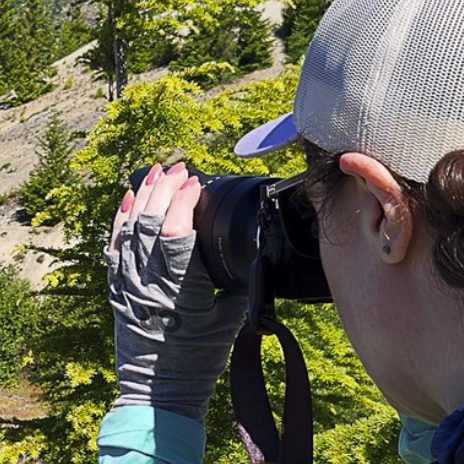
Left photo: The view of Spirit Lake opens below the trail. Right photo: A participant pauses to frame the recovering volcanic landscape.
The lake stretched before us like polished glass, reflecting a deep cobalt sky. To the southeast rose Mount St. Helens, her crater still crowned by a faint plume of wind-lifted ash–a quiet reminder that this mountain is not merely a monument to the past but a living volcano still reshaping herself. Forty-six years after the eruption, thousands of silver-gray logs continue to drift across Spirit Lake, moving slowly with the wind like silent witnesses to that extraordinary day. It is one of the few places on Earth where geology, ecology, and history remain so visibly intertwined.


Spirit Lake appears beneath an immense blue sky, with Mount St. Helens rising beyond the water.
Nature Becomes the Classroom
Patrick led us to one of his favorite teaching locations along the shoreline, where nature itself became the classroom.
Here the lesson wasn't simply about shutter speed or aperture.
It was about learning to see.


Patrick Aalto demonstrates how small shifts in framing and perspective can transform a landscape photograph.
With patience and remarkable clarity, Patrick demonstrated how light defines form, how composition guides emotion, and how small changes in perspective can transform an ordinary scene into something deeply personal. His teaching style was methodical yet inspiring, allowing each concept to unfold naturally within the landscape itself. Every example was rooted in observation rather than theory, encouraging us to understand not only how to make a photograph, but why.

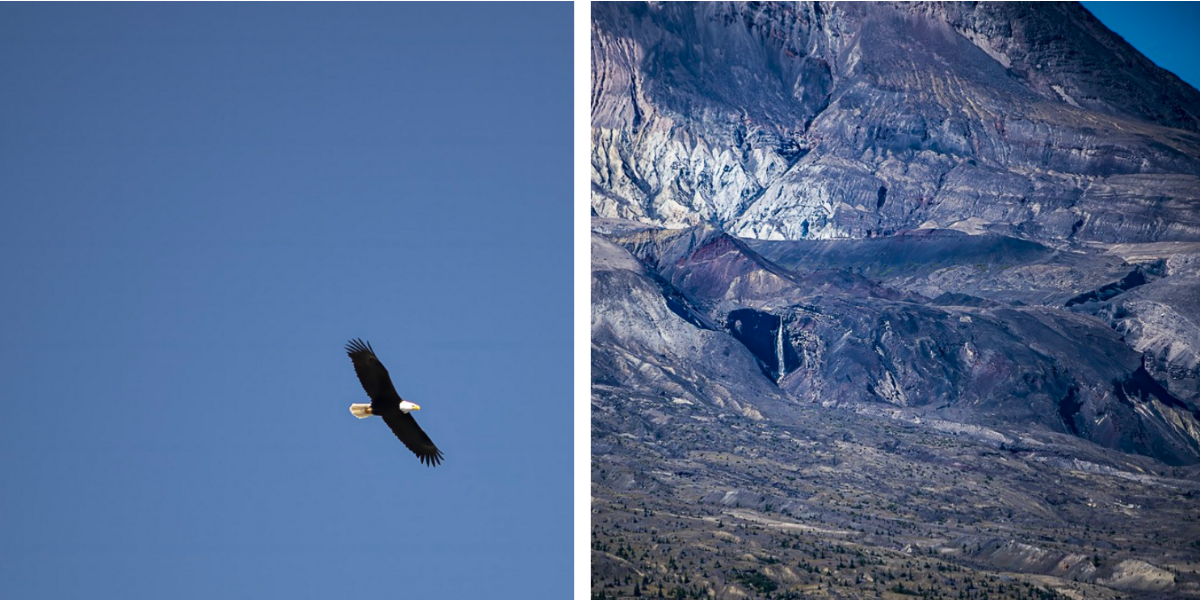
Left photo: A bald eagle circles above the lake. Right photo: A long-lens view reveals the crater, Crater Glacier, and Loowit Falls.
Hours Slipped Quietly By

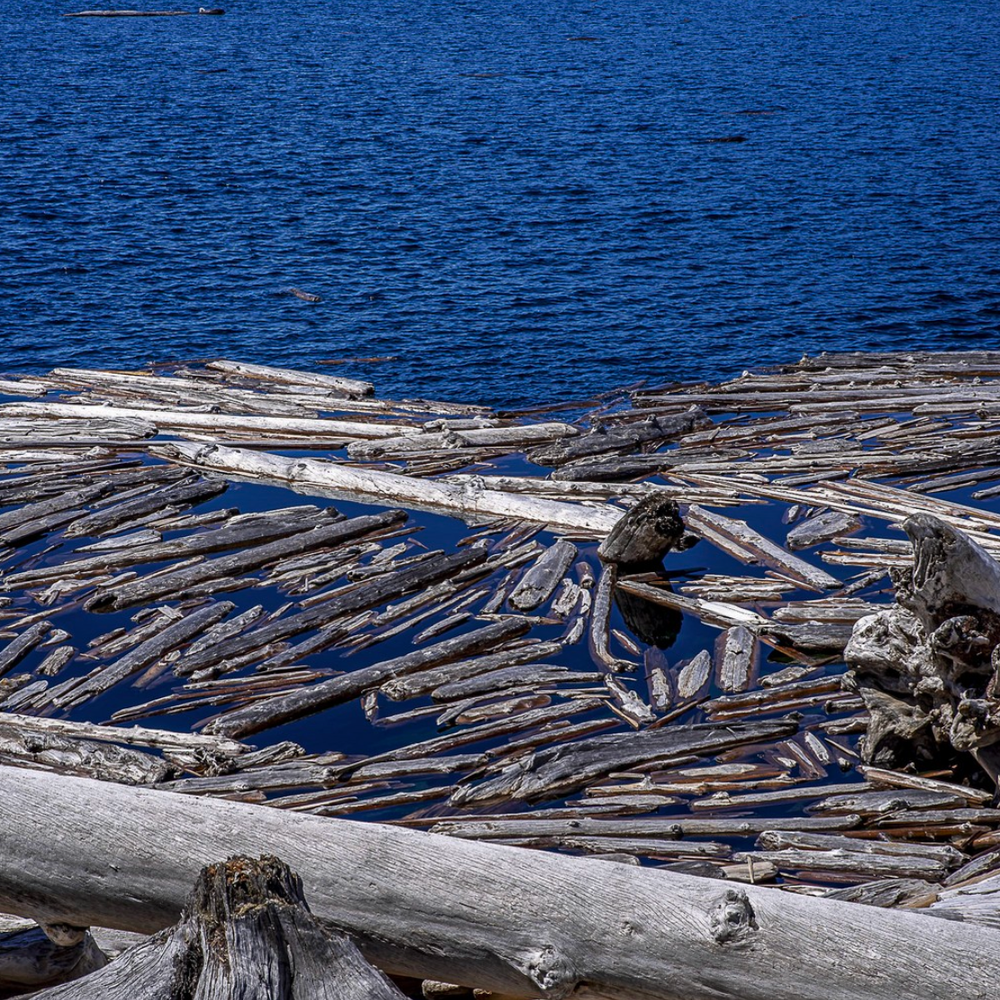
The floating log mat holds the physical memory of the 1980 blast.
The gentle sound of water brushing against ancient floating logs, the occasional cry of a bald eagle overhead, and the ever-changing light across the volcanic landscape created an atmosphere where creativity felt effortless. There was no rush. No pressure. Only the quiet invitation to look more carefully.


Driftwood, deep blue water, and the volcano form layers of history.
The shoreline offered lessons everywhere: repeating patterns in weathered wood, strong diagonals formed by fallen trunks, contrasts between living green and bleached timber, and reflections that changed with each passing breath of wind.
Where the Mountain Still Speaks


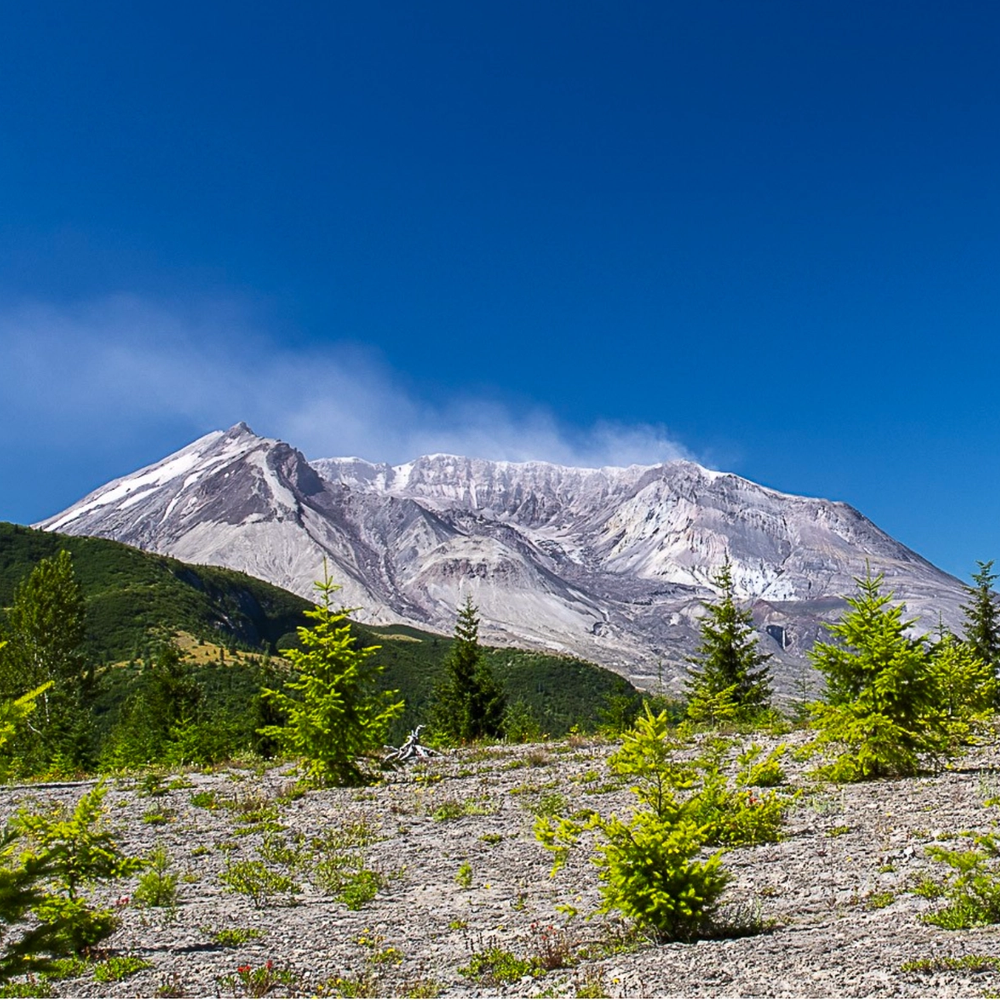
Wind lifts pale ash and fine sediment above the crater rim, briefly creating the appearance of volcanic smoke.
From across Spirit Lake, Mount St. Helens seemed close enough to study line by line. The broken crater rim, the pale glacier, the contrasting volcanic deposits, and the recovering forest form a landscape that is both beautiful and unsettled.
Under favorable dry and windy conditions, ash and fine sediment left by earlier eruptive activity can be lifted from exposed slopes. From a distance, the resulting plume can resemble smoke. In this photograph, the drifting veil becomes a visual echo of 1980–not a new eruption, but the mountain briefly raising its own history into the sky.
Tired Legs, Full Hearts
Eventually the time came to shoulder our packs and begin the long climb back toward Harmony Trailhead.
The ascent reminded us that every meaningful journey requires effort. Legs grew tired, and conversations became quieter, but smiles remained. We returned carrying more than memory cards filled with photographs. We carried a renewed appreciation for the mountain, a deeper understanding of our craft, and the shared experience of seeing one of nature's most powerful landscapes through new eyes.


At the end of the hike: tired legs, full memory cards, and a shared sense of discovery.
Photography often teaches us to chase beautiful light.
The MSHI Photography Hikes teach something even more valuable.
They remind us that sometimes the greatest images appear only after we slow down long enough to hear what the mountain has been trying to tell us all along.