Blogs
Learning Resources
General Resources
15 Min Read
Spirit Lake: From an Emergency Tunnel to a Long-Term Vision
Dan Tormey
Pubished - November 09, 2026

Spirit Lake: From an Emergency Tunnel to a Long-Term Vision
How science, engineering, and community collaboration are shaping the future of one of Mount St. Helens' most remarkable landscapes
A Lake Transformed
On May 18, 1980, the eruption of Mount St. Helens changed the landscape of the Pacific Northwest in a matter of minutes. A massive landslide swept down the volcano's northern flank, burying valleys, rerouting rivers, and blocking the natural outlet of Spirit Lake to the North Fork Toutle River.
The eruption raised the lake approximately 200 feet above its former elevation. With its natural outlet blocked by millions of cubic yards of volcanic debris, Spirit Lake began filling with water. If the lake rose high enough to breach the blockage, a catastrophic flood and mudflow could sweep down the Toutle and Cowlitz Rivers, threatening communities as far downstream as Longview and Kelso.
The federal government responded with emergency pumping facilities in 1982, followed by construction of an 8,465-foot-long tunnel through Harry's Ridge in 1984–1985. This tunnel provided a permanent outlet for Spirit Lake, allowing water to drain safely into South Coldwater Creek and ultimately the North Fork Toutle River.
For more than 40 years, the tunnel has performed an essential public safety function. But it was constructed under emergency conditions, through geologically challenging rock, and was never intended to operate indefinitely without substantial maintenance.
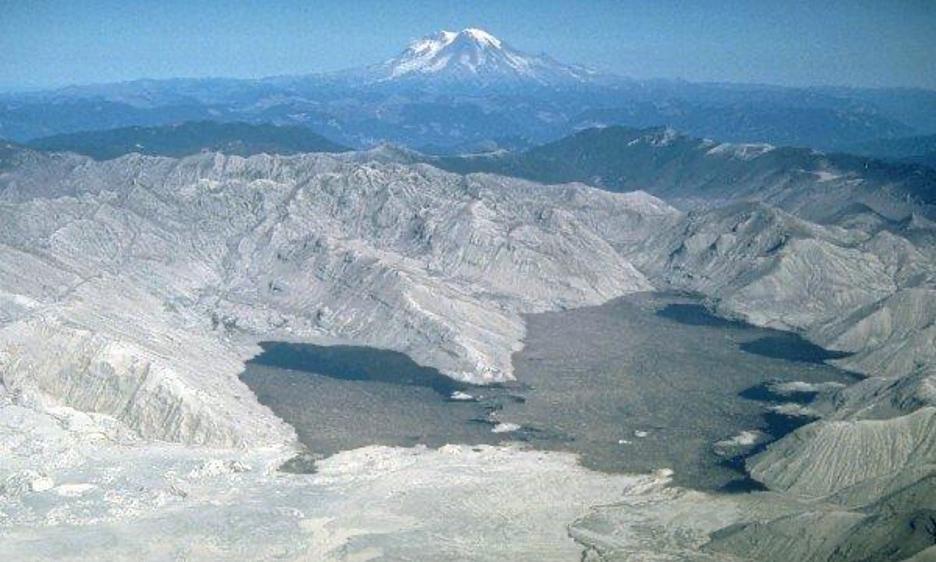
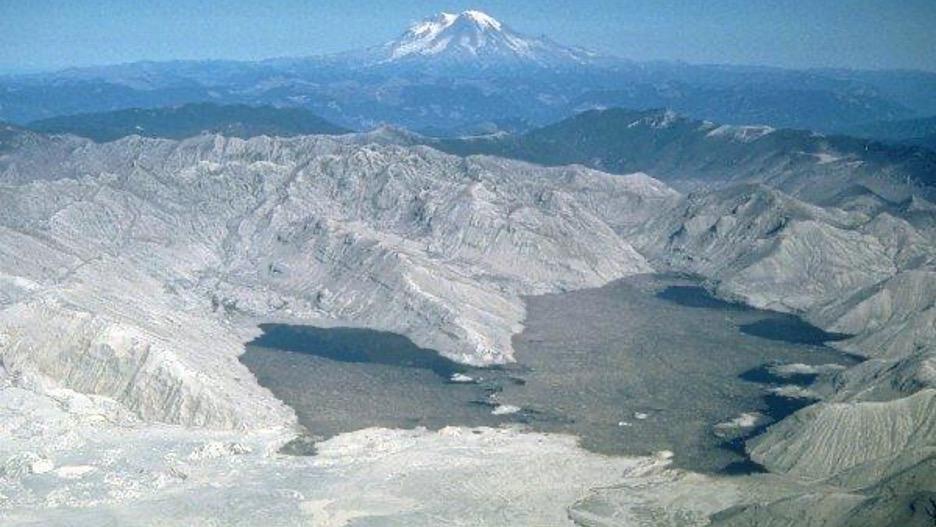
Spirit Lake, once surrounded by lush forest, is within the area devastated by blast from Mount St. Helens. Remnants of the forest float on the surface of the lake. October 4, 1980. Another Cascade volcano, Mount Rainier, is in the distance. USGS Photograph taken by Lyn Topinka.
The Close Calls That Changed the Conversation
The existing outflow tunnel passes through several zones of fractured and weakened volcanic rock. Over time, pressure from the surrounding rock has deformed portions of the tunnel, causing its floor to rise and damaging its supports.
Major repairs were necessary in 1995–1996 and again in 2016–2017. Both repairs required closing the tunnel for extended periods. Both closures coincided with unusually wet conditions, and Spirit Lake rose to near its designated maximum safe operating elevation of 3,460 feet.

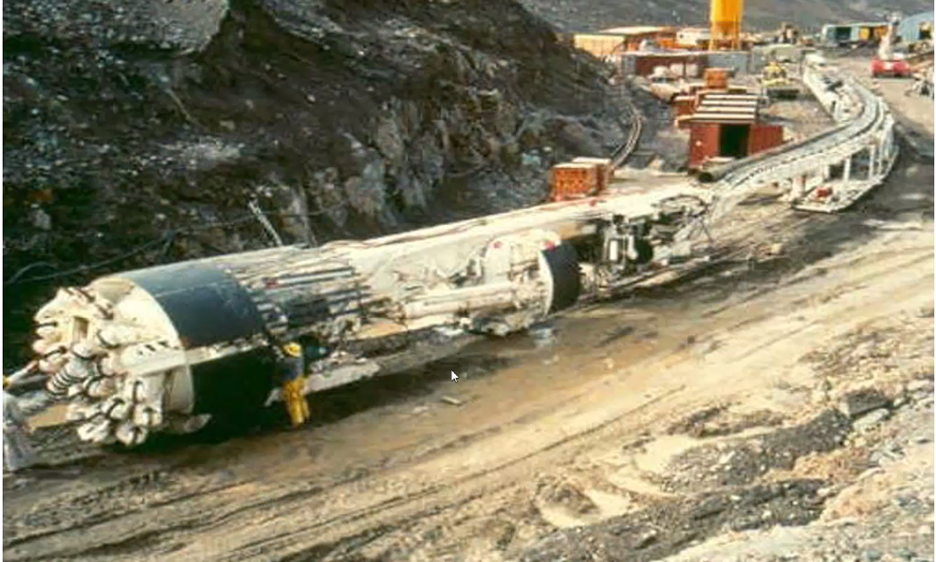
11-foot diameter tunnel boring machine at Spirit Lake. US Army Corps of Engineers.
These experiences exposed a fundamental vulnerability: management of Spirit Lake currently depends on a single aging outlet, with no permanent backup system to manage rising water levels while the tunnel is closed.
The consequences of failure could be enormous. Approximately 50,000 people live downstream in areas potentially affected by catastrophic flooding and mudflows. Yet the problem could not be solved by engineering alone. Spirit Lake sits within the Mount St. Helens National Volcanic Monument, where Congress directed the Forest Service to protect geological, ecological, and cultural resources while allowing natural processes and ecological recovery to continue substantially unimpeded.
How could the Forest Service protect downstream communities while honoring the very natural processes, scientific opportunities, and landscape values for which the Monument was created?
In September 2015, members of Washington's congressional delegation asked the leaders of the Forest Service, U.S. Army Corps of Engineers, and U.S. Geological Survey to work together on a long-term solution. That request launched an ambitious scientific, engineering, and public engagement effort.
Science First, Then a New Way of Making Decisions
The Forest Service brought together leading scientific and engineering expertise. Researchers from the U.S. Geological Survey and Forest Service examined the volcano's geological history, the stability of the debris blockage, sediment transport, and potential future hazards. The U.S. Army Corps of Engineers evaluated engineering options and their associated risks.
The National Academies of Sciences, Engineering, and Medicine (NASEM) was also commissioned to examine how decisions about Spirit Lake and the broader Toutle River system should be made. Its 2018 report recognized something fundamental: there is no risk-free solution for managing Spirit Lake. All options involve uncertainties and tradeoffs among public safety, natural processes, environmental protection, research, recreation, and community interests.
Rather than recommending a single engineering solution, NASEM recommended a collaborative decision-making framework, including a technique known as Multi-Criteria Decision Analysis (MCDA).
The basic idea is straightforward: 1) develop a common scientific and technical understanding of the available options; 2) identify the different things people value; and 3) use a transparent method to examine how different priorities affect which management solutions are preferred.
Different people might reasonably arrive at different choices, even when working from the same scientific evidence. The challenge was to create a process in which those differences could be understood and discussed constructively.
Bringing the Community Into the Process
Following NASEM’s recommendations, the Forest Service implemented an extensive outreach effort that went well beyond the usual requirements for environmental review.
A particularly important part of this work was the Spirit Lake/Toutle-Cowlitz River Collaborative, which brought together Tribal representatives, federal and state agencies, local governments, conservation organizations, scientists, and community members. The Collaborative met approximately monthly during two years of focused discussions, examining scientific findings, engineering possibilities, environmental concerns, and the values that different participants brought to the decision. Additional meetings engaged researchers, conservation organizations, and local communities.
These conversations made a difference. One of the most important ideas to emerge was that the project could do more than improve the existing tunnel. It might also create a pathway toward reconnecting Spirit Lake with the North Fork Toutle River, restoring some of the natural hydrological and ecological processes interrupted by the 1980 eruption.
This concept combined a new, highly controllable pressure tunnel with the potential for future development of a natural habitat channel. The channel would not replace the engineered public safety system. Instead, the tunnel would maintain safe lake levels while scientists and engineers carefully evaluated how a surface channel could be established, potentially allowing fish to move between Spirit Lake and downstream waters.
This was a significant conceptual advance: engineering designed not simply to control nature, but also to create opportunities for natural processes to function safely. This approach is known as Engineering With Nature® (EWN) or, more broadly, Nature-Based Solutions.
Comparing the Alternatives
With support from engineering consultants Delve Underground and environmental consultants Catalyst Environmental Solutions, the Forest Service conducted an environmental review of the project in accordance with the National Environmental Policy Act (NEPA), evaluating nine alternatives for an outflow solution, including taking no new action. These alternatives ranged from repairing or replacing the existing tunnel to creating new outlets through the volcanic debris blockage.
The engineering feasibility analysis examined how well the options could function, what risks they would present during construction and operation, and their potential costs. The NEPA Environmental Impact Statement (EIS) evaluated effects on fish and wildlife, wetlands, sediment transport, cultural resources, research, recreation, scenery, and other resources.
The project team also developed an MCDA tool consistent with NASEM’s recommendations. It brought together three major dimensions:
- Comparative risk: How reliably could each alternative protect downstream communities?
- Community values: How well did the alternatives address priorities such as public safety, healthy ecosystems, research, education, and recreation?
- Environmental consequences: What effects would each alternative have on the Monument and surrounding watershed?

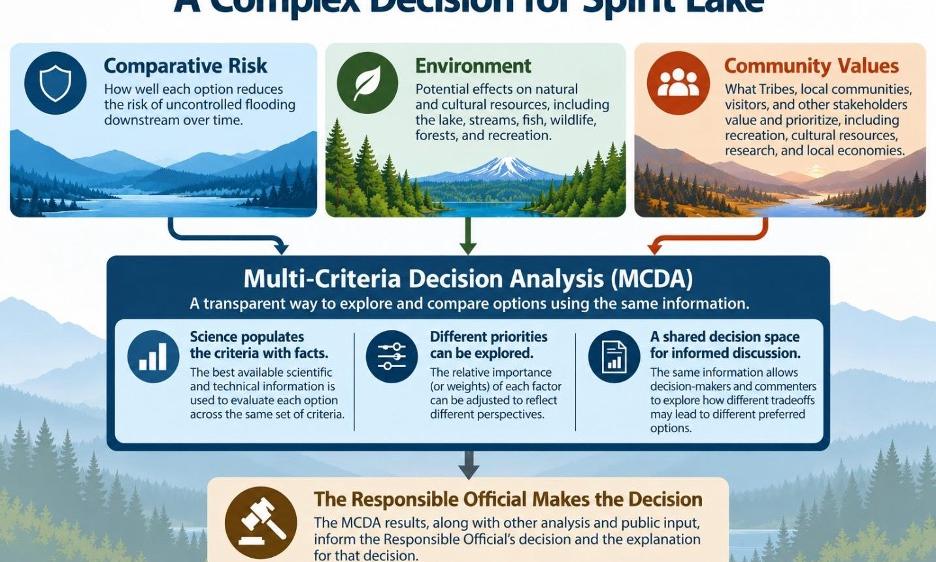
The tool helped explain why different perspectives could lead to different preferences. Two alternatives emerged as preferred approaches in the Draft EIS released in August 2025.
One, Alternative 2+9, would rehabilitate the existing tunnel and lower the normal lake level to provide more storage capacity during future repairs. This approach would generally minimize new construction and disturbance.
The other, Alternative 7, which was borne out of discussions in the Collaborative, would build a new pressure tunnel, retain the existing tunnel as a backup, improve long-term access, and establish a phased pathway for potentially developing a natural habitat channel. Alternative 7 would involve greater landscape disturbance, but offer additional operational flexibility, physical redundancy, and opportunities for ecological connectivity.
The Forest Service provided a 90-day public comment period for the Draft EIS, during which public commenters engaged with the MCDA framework itself. Rather than simply stating support or opposition, many explained the values and priorities underlying their preferences. This was one of the most encouraging results of the MCDA tool: a shared framework for discussing a genuinely difficult decision. The MCDA does not make the decision. That responsibility belongs to the Gifford Pinchot Forest Supervisor, who considers the scientific analysis, public input, agency responsibilities, and competing values. The tool makes the reasoning more transparent, allowing people to understand why different priorities may lead to different preferences, and ultimately why the Forest Supervisor selects a particular alternative.
Where the Project Stands Today
Following public review of the Draft EIS, the Forest Service evaluated and responded to public comments, which are presented in the Final EIS. In July 2026, the Forest Service released its Final EIS and Draft Record of Decision (ROD), identifying Alternative 7 as the proposed selection. The Draft ROD describes the reasons for that choice, including improvements in public safety, operational reliability, redundancy, and opportunities for long-term ecological connectivity. The proposed decision also recognizes that a future habitat channel would require additional engineering, scientific analysis, collaboration, monitoring, and applicable approvals before it could be implemented.
The project has proceeded through the Forest Service's administrative objection-review process. The Forest Service is completing the remaining steps required before issuing a final Record of Decision. Even after a final decision, constructing a new outlet system will take additional engineering, funding, permitting, and time. The existing tunnel will continue to play an essential role in managing Spirit Lake during that process.
A Long-Term Commitment to a Living Landscape
Spirit Lake offers a remarkable lesson about Mount St. Helens: the eruption did not end in 1980. Its geological and ecological consequences are still unfolding and will continue for generations.
The same is true of the human story. The Mount St. Helens National Volcanic Monument exists because people cared deeply about protecting this landscape. That commitment continues today through the work of Tribes, scientists, educators, conservationists, public agencies, and local communities, even when they hold different views about the best way forward.
The Spirit Lake Outflow Safety Improvement Project represents a continuation of that stewardship. It began with a straightforward but consequential public safety problem and evolved into an effort to combine engineering, science, and community values in a transparent decision-making process.
The ultimate goal remains clear: protect downstream communities while preserving the extraordinary opportunity Mount St. Helens provides to witness, study, and learn from a unique landscape that is still changing.
After all, the mountain is not finished telling its story. Neither are we.
Curious to learn more about the Spirit Lake Outflow Safety Improvement Project? Learn more:
- USFS Page on the project
- Project documents including the Record of Decision and the Environmental Impact Statement